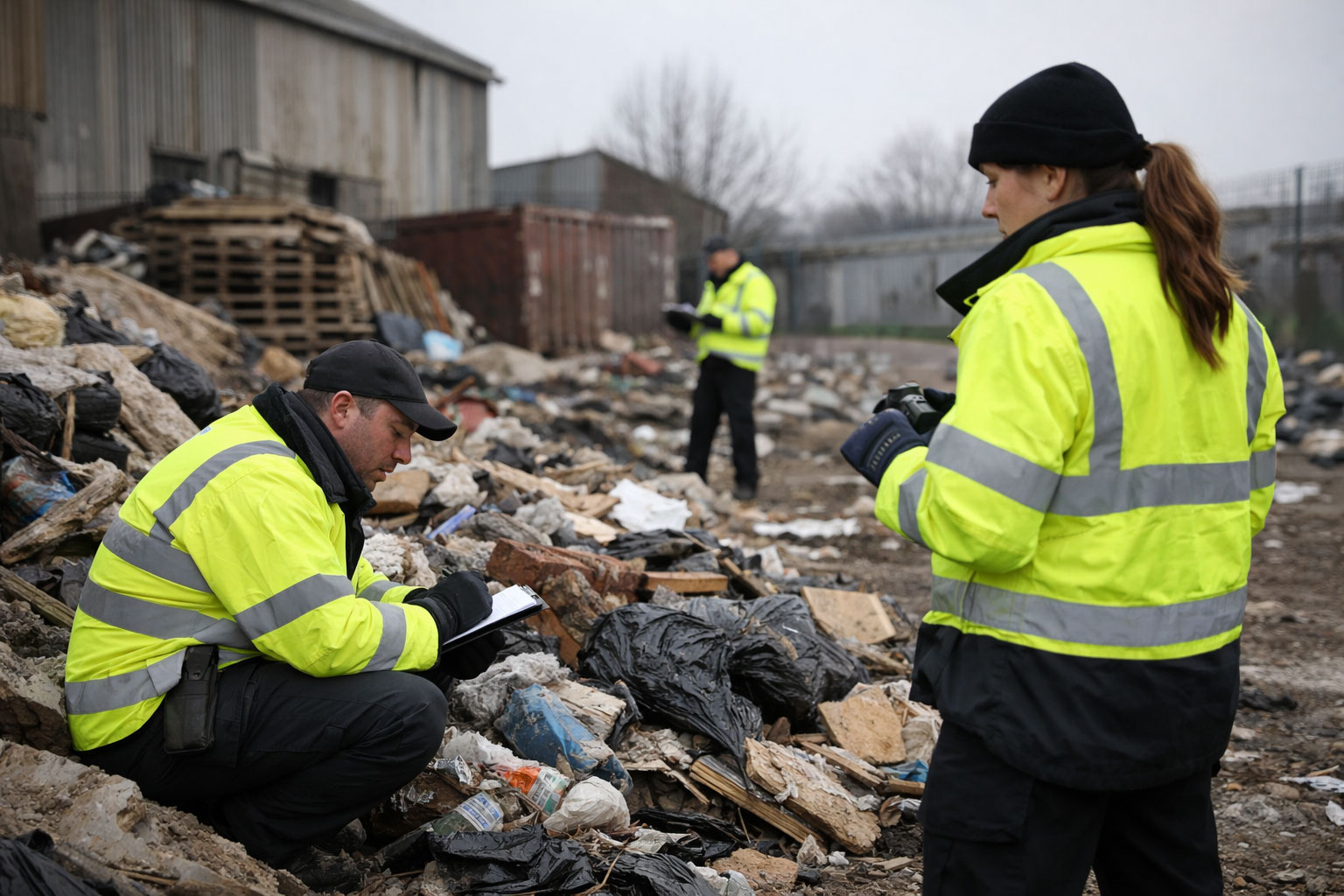
The Action Plan is built around three priorities:
- Prevent waste crime before it starts or escalates
- Enforce against offenders more effectively
- Remediate the damage caused by illegal waste activity
Together, these measures are intended to strengthen the waste regulatory system, close off loopholes and give regulators and local authorities more effective tools to act.
1. Prevention
A major part of the plan is making the waste system harder to exploit by closing the gaps that criminals currently use.
Key prevention measures include:
- Reform of the carriers, brokers and dealers (CBD) regime: Defra plans to move the current registration-based system into the environmental permitting regime. This would give the Environment Agency (EA) stronger powers to oversee compliance and increase penalties for offenders to up to five years’ imprisonment.
- Introduction of digital waste tracking: The government is replacing paper-based waste movement records with a UK-wide digital system. The service is expected to begin rollout from April 2026 for licensed and permitted waste receiving sites, including recycling centres and treatment facilities, before becoming mandatory in phases from October 2026 and expanding further across the sector.
- Tighter waste permit exemptions: Defra plans to remove three exemptions and tighten seven others that have been vulnerable to abuse. Record-keeping requirements will also be strengthened, alongside greater flexibility for the EA to act where exemptions are being misused.
More powers and earlier intervention
The plan also sets out a stronger operational approach from regulators, including:
- Expanded use of restriction notices: The EA will increase its use of restriction notices, enabling it to require operators to stop activity immediately where there is a serious risk of environmental harm.
- Greater use of permit suspensions, revocations and deregistration powers:
These powers will be used more actively where operators are linked to illegal activity or persistent non-compliance.
- Tax-check rules extended into the waste sector: HMRC is being brought more directly into the system to make it harder for rogue operators to continue trading while avoiding their tax obligations.
- Updated tools for local authorities: The plan highlights updated statutory guidance on litter enforcement powers, a revised Code of Practice on Litter and Refuse, and new best-practice guidance on the use of vehicle seizure powers linked to waste crime.
- A new online Waste Hub: The EA has launched an online Waste Hub to improve transparency and help the public report suspected illegal activity.
2. Enforcement
A central element of the Action Plan is increased investment in enforcement capacity.
The government has committed a further £45 million for the Environment Agency over the next three financial years, on top of a previously announced £5.6 million increase for the current year.
This funding is expected to support:
- Increased on-the-ground enforcement activity
- A more intelligence-led approach to tackling organised waste crime
- A new Operational Waste Intelligence and Analysis Unit, bringing together drone and satellite imagery, financial intelligence and criminal data
The Joint Unit for Waste Crime (JUWC) is also being expanded to 20 staff, including additional specialists such as former police officers.
The government is also exploring whether the EA should be granted enhanced powers aligned with the Police and Criminal Evidence Act and the Proceeds of Crime Act, reflecting the increasingly organised and financially motivated nature of waste crime.
Technology and data at the centre of the response
Advanced technology is a major theme throughout the Action Plan.
The EA has expanded its use of drone technology, with plans to introduce Light Detection and Ranging (LiDAR) capability to map illegal waste sites and capture more accurate data on waste volumes and site changes. The aim is to strengthen evidence collection and improve prosecution outcomes.
The agency is also using new tools to screen HGV operator licence applications, allowing it to identify businesses that may be transporting waste illegally.
At the same time, data-sharing is being strengthened with HM Land Registry and HMRC, improving intelligence on land ownership and waste shipments, including areas where regulators have historically had poor visibility.
Tougher penalties for offenders
The government is also looking to strengthen penalties, so they act as a more meaningful deterrent.
Measures under consideration include:
- Penalty points on driving licences for fly-tipping offences, which could lead to disqualification for repeat offenders.
- Conditional cautions for fly-tippers, which could require offenders to carry out up to 20 hours of unpaid clean-up work and repay the cost of clearing waste.
- Increased use of public naming of illegal waste operators
The government is also exploring ways to share intelligence on waste criminality with banks and finance providers, with the aim of making it harder for offenders to access financial services.
3. Remediation
The third part of the plan focuses on addressing the damage caused by illegal waste activity.
While landowners typically remain responsible for securing land and clearing illegally dumped waste, the government has stated that the EA will continue to intervene in exceptional cases where sites pose an unacceptable risk to communities or the environment.
Initial feasibility assessments for potential clearance will begin at several high-priority sites, including:
- Alan Ramsbottom Way, Hyndburn
- Worthing Road, Sheffield
- Bolton House Road, Wigan
These sites have been identified based on factors such as waste volume, hazardous materials, proximity to homes and sensitive habitats, and the level of local concern.
Defra is also exploring an insurance-based approach to help protect farmers, landowners and businesses from the financial impact of illegal dumping, alongside a potential Landfill Tax rebate mechanism to support the clearance of high-risk sites.
What this means
The new Action Plan marks a significant shift in tone and approach.
For legitimate operators, it points to a system with tighter controls, improved tracking, stronger enforcement and greater accountability.
More broadly, it shows that government is seeking to move from a reactive approach to a more preventive, intelligence-led and zero-tolerance response to waste crime.
Find out more about the governments Waste Crime Action Plan here.
How Clarity can support you
As enforcement activity increases, many organisations are reviewing how their waste is managed and the level of visibility they have across their waste streams.
With Recycle with Clarity, you can:
- Maximise the commercial value of your waste materials
- Work with established and reliable recycling and recovery partners
- Gain clearer visibility and reporting on how waste is managed downstream
- Strengthen oversight of your waste processes and data
Find out how Recycle with Clarity can support your organisation. Get in touch with one of our recycling experts to book a free recycling site inspection today.