Extended Producer Responsibility: The Complete Guide
Last updated: 11/05/2026

Extended Producer Responsibility (EPR) requires packaging producers to fund the full cost of managing packaging waste. This includes collecting, sorting, treating, and recycling. Brand owners and producers will now cover these costs through local councils – costs that previously fell to taxpayers.
As before, producers and importers continue to fund the recycling process itself by purchasing Packaging Recovery Notes (PRNs) which you will continue to receive through your compliance scheme.
Packaging producers obligated under EPR will have been collecting detailed packaging data since January 2023.
Large producers submit packaging data twice per year: in April (covering July to December of the previous year) and in October (covering January to June of the current year).
Small producers submit once per year in April, covering packaging activities across the previous calendar year (January to December).
(Click image to open in a new tab)
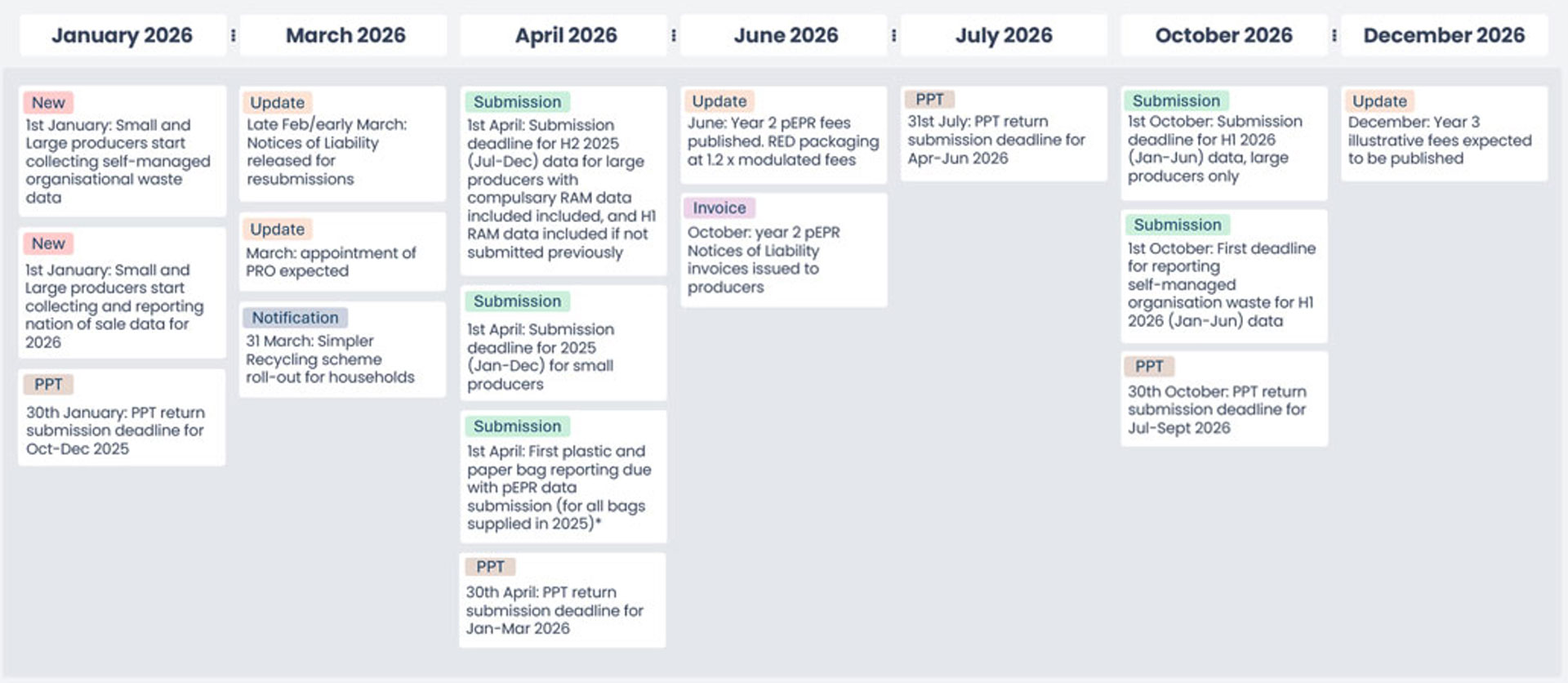
*RPS update, the EA has delayed data collection until 1st January 2026, with reporting required by 1st April 2027
Organisations with a turnover of more than £1 million and placing over 25 tonnes of packaging onto the UK market must report under the EPR regulations.
(Click image to open in a new tab)

Within this threshold, there are two main categories of producers:
Small Producer
You are considered a ‘small producer’ if you meet either of the following criteria:
Large Producer
You are considered a ‘large producer’ if you meet both of the following criteria:
The first step for any producer obligated under EPR is to enrol on the Report Packaging Portal (RPD) to receive an Organisation ID. This enrolment is a mandatory EPR requirement.
It must to be completed by a Companies House director within your business. If your business is not on Companies House, you must provide evidence that you are a senior contact. Your compliance scheme cannot complete this step on your behalf. Once registered, your compliance scheme will require your Organisation ID to facilitate your data submission.
See more about the RPD Portal in our FAQs:
What is Household and Non-Household packaging?
Understanding whether packaging is classified as household or non-household is a fundamental part of EPR. This distinction affects how you assess and report your packaging, and ultimately the fees you need to pay.
Household Packaging
Household packaging refers to materials that are typically thrown away by consumers at home and items commonly discarded in public bins. A category of household packaging is:
Household packaging classes include:
If you supply household packaging, there are additional responsibilities to consider:
For more details, please refer to the government’s guidance on household packaging.
Non-Household Packaging
Non-household packaging is typically used by businesses or public organisations and does not end up in consumer waste. Packaging is automatically considered household until evidenced otherwise. Non-household packaging classes include:
Packaging can also be classed as non-household if:
Producers need to keep records to show why packaging is classified as non-household. These records must be kept for at least seven years.
For more details, please refer to the government’s guidance on non-household packaging.
As a small producer, you will be responsible for the following:
As a large producer, you will be responsible for the following:
Producers need to gather accurate data on the type, weight, and material of all packaging they place on the market. This includes specific details on each material used, considering its recyclability. Producers should also capture data on the intended use, such as household or non-household packaging, to ensure compliance with EPR requirements. Collecting this data thoroughly helps streamline reporting and supports sustainable choices across the supply chain and ensures accurate payments:
You should categorise your data by the following materials:
‘Other’ includes any materials you use that are not listed above including: bamboo, ink, ceramic, copper, cork, hemp, rubber, silicon.
This refers to how you place packaging onto the UK market.
This refers to whether your packaging is:
Large organisations will need to report whether the packaging:
What are the producer types under EPR?
There are 6 producer types under EPR with the single point of compliance often falling on the brand owners or importers. Your producer type relates to your packaging activity, which is how you place packaging onto the UK market.
A brand owner: an organisation that supplies packaged goods to the UK market under your own UK owned brand. Also referred to as ‘supplied under your brand’.
A packer/filler: an organisation that places goods into packaging when supplied onto the UK market. Also referred to as ‘packed or filled as unbranded’.
An importer: an organisation that imports packaged goods from outside the UK, who then go on to supply these products to the UK market. This also includes discarding packaging around an import. Also referred to as ‘imported’.
A distributor: an organisation that supplies unfilled packaging to a company who is not a large producer, subject to obligations, who then go on to supply that packaging to the UK market. Also referred to as ‘supplied as empty’.
A service provider: an organisation that hires or loans out reusable packaging. Also referred to as ‘hired or loaned’.
An online marketplace operator: an organisation that operates a website or app that enables businesses or persons to place their packaged items or goods onto the UK market from outside the UK. If a large producer supplies it on again, the responsibility falls back to the distributor. Also referred to as ‘supplied through an online marketplace that you own’.
Seller: An organisation that provides packaging direct to the end user.
With EPR waste collection costs and funding have changed. Here’s a general overview to help producers understand reporting obligations and fees:
Data Reporting and Compliance: Obligated producers must submit detailed packaging data at least twice a year. This may require additional administration and system updates within your business, particularly to ensure accurate, regular data submissions.
PRNs: Obligated producers must purchase Packaging Recovery Notes (PRNs) to meet their recycling obligations. This remains in place under EPR and ensures that producers contribute financially to the recycling process itself. Small producers will not have an obligation to acquire PRNs.
Local Authority Waste Management Fees: Any packaging reported as ‘household’ will be subject to this fee. Obligated producers are then responsible for the costs of collecting, sorting, and treating household packaging waste, covering the full net cost. The EPR Local Authority Waste Management Fee payment is issued after the government has processed H2 and is paid directly to the Scheme Administrator.
Commercial packaging waste: For now, businesses that dispose of commercial packaging waste remain responsible for funding its collection and recycling.
Small producer obligations: Businesses that are classed as small producers do not currently have financial obligations under EPR, outside of the Environment Agency fees and compliance scheme membership costs.
Modulated fees, also known as eco-modulation, are a key part of the UK’s Extended Producer Responsibility (EPR) system. They are designed to encourage more recyclable household packaging by adjusting Local Authority Waste Management fees based on recyclability performance.
Under the Recyclability Assessment Methodology (RAM), household packaging materials are assessed and assigned a red, amber or green outcome, which is then used to modulate the base fee. Packaging that is easier to recycle is expected to attract lower fees than packaging that is more difficult to recycle.
As part of EPR reporting obligations, producers are required to submit additional recyclability data for household packaging placed on the market. This information is used to determine how Local Authority Waste Management fees are modulated.
The Recyclability Assessment Methodology (RAM) is a key component of the UK’s Extended Producer Responsibility (EPR) framework and a central mechanism for calculating modulated fees. Through RAM, businesses assess the recyclability of their packaging materials to determine their associated fees, with easier-to-recycle packaging incurring lower costs. This requirement applies to “household” packaging and is designed to encourage producers to choose recyclable materials.
Using RAM, businesses assess each packaging component and assign it a Red, Amber, or Green rating, reflecting its recyclability. Components rated Green incur the lowest fees, while Red components, which are challenging to recycle, incur the highest fees. These ratings then modify the base fee for each material, creating financial incentives to reduce waste and support sustainable design.
Producers are expected to submit their recyclability assessments starting in January 2025, in line with EPR’s implementation schedule.
Read our guide on the Recyclability Assessment Methodology (RAM)
Producers were initially required to label packaging as ‘Recycle’ or ‘Do not Recycle’ by March 2027. However, in October 2024, the UK government removed this requirement to support EPR rollout and ensure consistency for large producers operating in both the UK and EU.
Producers of in-scope DRS drinks containers are not liable for Local Authority Waste Management fees (waste disposal fees) for those containers. However, obligated producers are still required to meet recycling obligations through PRNs/PERNs for packaging they place on the market.
PRNs subsidise the cost of actual recycling in the UK, whereas EPR will cover the full net cost of the collection, treatment and sorting costs of packaging waste. The PRN system remains in place under EPR so obligated large producers will continue to purchase PRNs.
Businesses obligated under EPR will be required to:
Under Extended Producer Responsibility, the purchasing of P(E)RNs remains the mechanism through which obligated businesses comply with their recycling obligations. Obligated businesses will continue to purchase P(E)RNs as they do now; however, there will be an additional Local Authority Waste Management fee to cover the full net cost of collection, treatment and sorting of packaging waste.
The Report Packaging Data (RPD) portal is a secure online system, provided by the UK government, where businesses report data about the packaging they handle. It is a vital part of EPR as all obligated producers must register on the portal before making a packaging data submission.
To register, you’ll need a director listed on Companies House to create an account. This process generates a unique Organisation ID that you will need to provide to your compliance scheme.
Access the RPD portal here.
If you are facing any difficulties, please contact our team of compliance experts who will be able to assist: info@clarityenv.eu
Do you or your business require further information about EPR? Reach out to our team of experts to book a free EPR consultation to review your business needs.
Alternatively, if you are a Comply with Clarity member and require further information on the revised timetable and your responsibilities, please get in touch utilising the form below, your compliance manager will respond to any of your questions.
Our compliance scheme provides environmental compliance to businesses and a seamless transition to Extended Producer Responsibility for packaging. Read more about our Packaging Compliance Scheme.