EPR Fees Explained
How EPR fees are structured and what they mean for producers.

The financial obligations created by Extended Producer Responsibility for packaging (pEPR) fall into three main categories.
Understanding how these charges are structured is essential for budgeting, compliance planning, and long-term packaging design decisions.
All obligated producers must register either directly with their environmental regulator or through an approved packaging compliance scheme.
Registration ensures that the business is formally recognised within the EPR system and that its packaging data is submitted correctly to the regulator.
The current registration charges are:
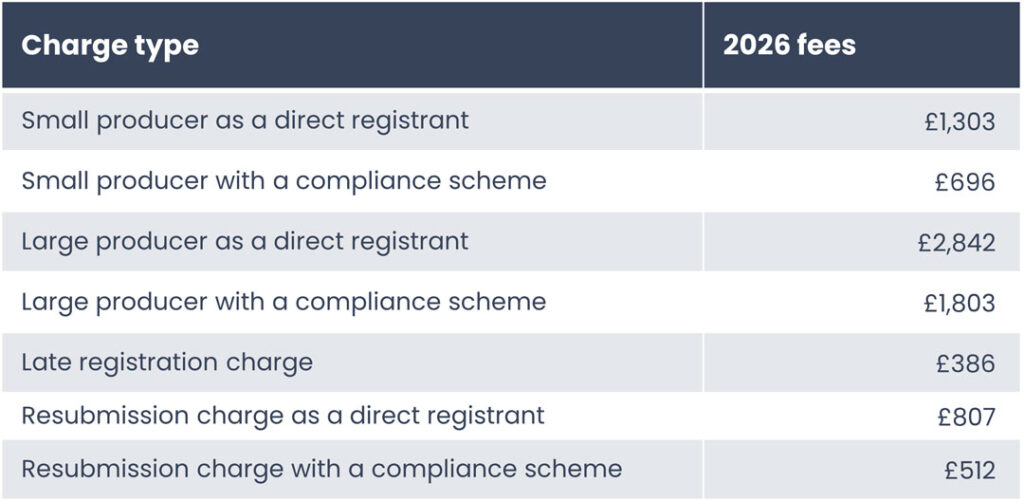
Direct registration with the regulator carries higher fees. For this reason, most producers choose to register through a compliance scheme, like Clarity, which manages reporting obligations, regulatory submissions and PRN procurement on their behalf. Compliance schemes will typically charge additional service fees depending on the level of support required.
Businesses should also be aware that late submissions, resubmissions, and complex group structures can increase compliance costs.
The most significant financial impact of EPR comes from waste disposal fees.
These payments fund the collection, sorting and treatment of household packaging waste managed by local authorities. The fees are calculated based on the volume and type of household packaging placed on the UK market.
Charges are calculated on a per-tonne basis, with different rates depending on the material type as follows:
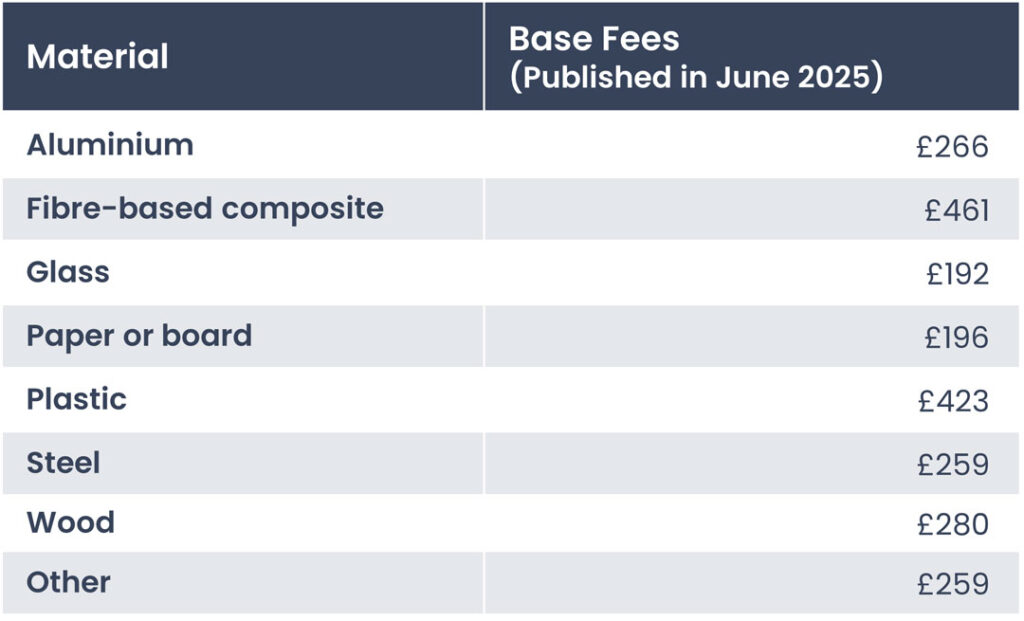
For businesses placing significant volumes of consumer packaging onto the market, these costs can quickly become one of the largest environmental compliance expenditures.
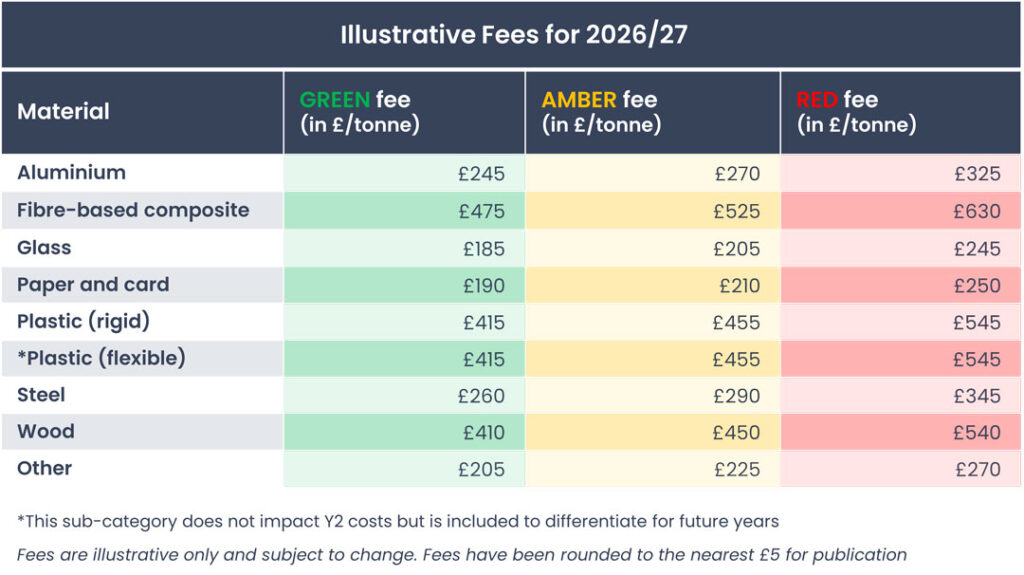
From 2026, disposal fees will become modulated, meaning they will vary depending on how recyclable the packaging is.
This will be determined using the Recyclability Assessment Methodology (RAM), which assesses whether packaging can be effectively collected, sorted and recycled within the UK system.
Packaging will be assigned a traffic-light rating:
Green – widely recyclable packaging with lower fees
Amber – packaging with some recyclability challenges
Red – difficult-to-recycle packaging with the highest costs
This means packaging design will directly influence compliance costs. Businesses that improve recyclability may benefit from lower EPR charges, while harder-to-recycle materials will incur higher fees.
Illustrative modulated fee by RAG (Red, Amber, Green) rating are as follows:
In addition to registration and disposal fees, producers must also meet their recycling obligations through Packaging Waste Recovery Notes (PRNs).
PRNs are evidence that a tonne of packaging material has been recycled. They are issued by accredited recycling facilities and must be purchased by producers to demonstrate that national recycling targets have been met.
For exported recycling, the equivalent evidence is called a PERN (Packaging Export Recovery Note).
Unlike registration or disposal fees, PRN prices are not fixed. They are determined by supply and demand in the recycling market.
Prices can fluctuate significantly throughout the year depending on factors such as:
Recycling capacity availability
Export market demand
Changes in recycling targets
Material shortages
For this reason, many large producers work with compliance schemes, like Clarity, that provide strategic PRN procurement and market intelligence to manage price volatility.
If a parent company registers a group of subsidiaries, an additional fee is charged by the environmental regulator for each subsidiary included in the registration.
Groups can register:
The first 20 subsidiaries pay £690 each.
Subsidiaries 21 to 100 pay £172 each.
No charge for subsidiaries after the hundredth.
For producers who choose to use the ‘closed loop’ recycling function to offset the weight of the household packaging they supply, there is an associated charge to use this function.
Annual charge to submit closed loop packaging data = £2,548
Under pEPR, “you’re classed as ‘owning an online marketplace’ if you operate a website or app that allows non-UK businesses to sell their goods into the UK.”
Online marketplace producers face a provisional additional charge of £2,885.
Our team of compliance experts can advise you on anything you need to know about your financial obligations under Extended Producer Responsibility.