You are here: Home / News / UK vs EU EPR: How Do the Systems Compare?

UK vs EU EPR: How Do the Systems Compare?

Extended Producer Responsibility (EPR) is now the foundation of packaging policy across Europe, and most countries have fully functioning EPR schemes. These schemes have always operated in different ways, but now countries in the EU will be harmonising their approach to producer responsibility by implementing the new Packaging and Packaging Waste Regulation (PPWR). This will result in notable differences between the UK and EU countries when it comes to packaging regulation requirements.

For producers that operate in both markets, export into the EU, or simply want to understand shifting global standards, a clear comparison is essential. This guide outlines where the two systems align, where they diverge, and what each means in practical terms for packaging, reporting, and future compliance costs.

Legal Framework and Governance

European Union:

EU packaging EPR is transitioning from the Packaging and Packaging Waste Directive (94/62/EC) to the new Packaging and Packaging Waste Regulation (PPWR).

  • Adopted: 2024
  • Entered into force: 11 February 2025
  • Applies from: 12 August 2026 (18 months after entry into force)

Because PPWR is a Regulation, it applies directly across all EU Member States.

Oversight remains with national regulators such as ADEME (France) and ZSVR (Germany).

United Kingdom:

The UK’s packaging EPR system is governed by the Producer Responsibility Obligations (Packaging and Packaging Waste) Regulations 2024.

Administration is handled by PackUK, which is a Defra hosted function delivering EPR functionality on behalf of the four nations.

Enforcement is delivered through:

  • Environment Agency (England)
  • Scottish Environment Protection Agency (SEPA)
  • Natural Resources Wales (NRW)
  • Northern Ireland Environment Agency (NIEA)

Comparison

  • EU: Once under PPWR, a harmonised legal framework applied across all member states.
  • UK: A standalone national system, with its own governance and timelines.

Who Is Obligated? (Scope & Producer Definition)

European Union:

Any company placing packaging on the EU market must comply, including importers, online marketplaces (OMPs) and own-brand retailers. Today, thresholds vary by Member State, but PPWR will harmonise digital reporting and definitions.

United Kingdom:

A business must comply if it:

  • Has an annual turnover of £1 million or more, and
  • Supplies or imports more than 25 tonnes of packaging in the previous calendar year.

Classification:

  • Small producers: ≥£1m turnover & >25 tonnes (or £1–2m turnover & >25 tonnes).
  • Large producers: ≥£2m turnover & >50 tonnes.

Comparison

  • EU: Thresholds differ today but will be standardised under PPWR.
  • UK: Thresholds are already fixed and nationally consistent.

What Producers Must Do (Registration & Reporting)

European Union:

Reporting requirements currently differ by country. PPWR will drive harmonised reporting requirements and data formats across the EU, even though national PRO systems and portals will continue to operate country by country.

United Kingdom:

Reporting is carried out via the government’s Report Packaging Data (RPD) service.

  • Large producers: Submit data every six months.
  • Small producers: Submit data annually.

Comparison

  • EU: Patchwork of national systems until PPWR standardisation begins.
  • UK: Centralised, single reporting system already in place.

How Fees Work (Funding, Disposal Costs & Modulation)

European Union:

Producers fund the collection, sorting and recycling of packaging waste, typically through Producer Responsibility Organisations (PROs).

Eco-modulated fees, which reward recyclable packaging and penalise unrecyclable formats, already exist in many Member States and will become mandatory under PPWR.

United Kingdom:

Producers pay EPR fees based on the amount and type of packaging placed on the market, funding the collection process for local authorities. Modulated fees (RAM) now apply based on recyclability of materials.

Comparison

  • EU: Long-established PRO-based modulation systems, soon harmonised under PPWR.
  • UK: A new RAM-based modulation framework, applied nationally and directly linked to recyclability.

Enforcement and Sanctions

European Union:

Enforcement varies by country but commonly includes:

  • Monetary penalties
  • Registration suspension
  • Market restrictions
  • Public listing of non-compliant producers under PPWR transparency rules

United Kingdom:

All 4 nations under different respective regulators, enforced under the Producer Responsibility Obligations (Packaging and Packaging Waste) Regulations 2024. Enforcement varies by country but commonly includes:

  • Fixed and variable monetary penalties
  • Compliance and restoration notices
  • Enforcement undertakings
  • Prosecution for severe offences

The EA publishes details of enforcement actions and accepted undertakings on GOV.UK to deter non-compliance.

Comparison

  • EU: Decentralised enforcement with EU-level transparency measures.
  • UK: An increasingly strict enforcement regime, strengthened by new civil sanction powers.

Strategic Direction of Travel

European Union:

PPWR sets ambitious long-term goals:

  • All packaging placed on the EU market to be reuseable or recyclable by 2030.
  • Bans on unnecessary or non-recyclable packaging formats.
  • Mandatory, harmonised consumer disposal labelling.
  • Design-for-recycling rules applying to all packaging types.

PPWR therefore integrates design, reuse, recyclability, and waste management under one framework.

To achieve a circular packaging economy, all packaging placed on the EU market must be reusable or recyclable by 2030 as part of PPWR targets.

United Kingdom:

To shift the cost of waste management from taxpayers to producers, increase recycling rates, and reduce “free-riding.”

The UK’s current direction centres on:

  • Stronger data transparency.
  • Recyclability-based modulation through RAM.
  • Incrementally increasing recycling targets to 2030.
  • Future reforms expected on packaging design, materials labelling, and potential expansion of reuse requirements.

Unlike PPWR, the UK approach separates design standards from the core EPR system for now.

Comparison

  • EU: Design-led, circular-economy-driven reforms with detailed rules and uniform implementation across Member States.
  • UK: Data-led and cost-led reforms, with design and reuse requirements likely to evolve more gradually.

What is PPWR?

The EU’s new Packaging and Packaging Waste Regulation (PPWR) ushers in a new era of producer responsibility, setting ambitious goals to reduce waste, improve recycling, and harmonise sustainability standards across Europe.

Purpose:

The PPWR is designed to:

  • Reduce packaging waste and prevent unnecessary packaging.
  • Harmonise rules across the EU (since it’s a Regulation, not a Directive, it applies directly in all Member States).
  • Improve recyclability and reuse of packaging materials.
  • Set clear design and labelling requirements for packaging.
  • Boost the use of recycled content in plastic packaging.
  • Support a circular economy and reduce greenhouse gas emissions from packaging.

Key proposals:

  • Packaging reduction targets for 2030 and 2040.
  • Minimum recycled content requirements for plastic packaging.
  • Clear labelling rules for consumers on how to dispose of packaging.
  • Ban on certain types of packaging (e.g., unnecessary single-use formats).
  • All packaging must meet recyclability-by-design requirements by 2030, with additional binding reuse targets for specific sectors such as takeaway food and beverages.

PPWR does not replace the EU EPR framework, it complements it. PPWR is an EU regulation (directly applicable by law) governing how packaging should be designed, labelled, reused, and recycled across the EU.

EU EPR is a policy mechanism within EU environmental law, to ensure that producers pay for the end-of-life management of the packaging they place on the market.

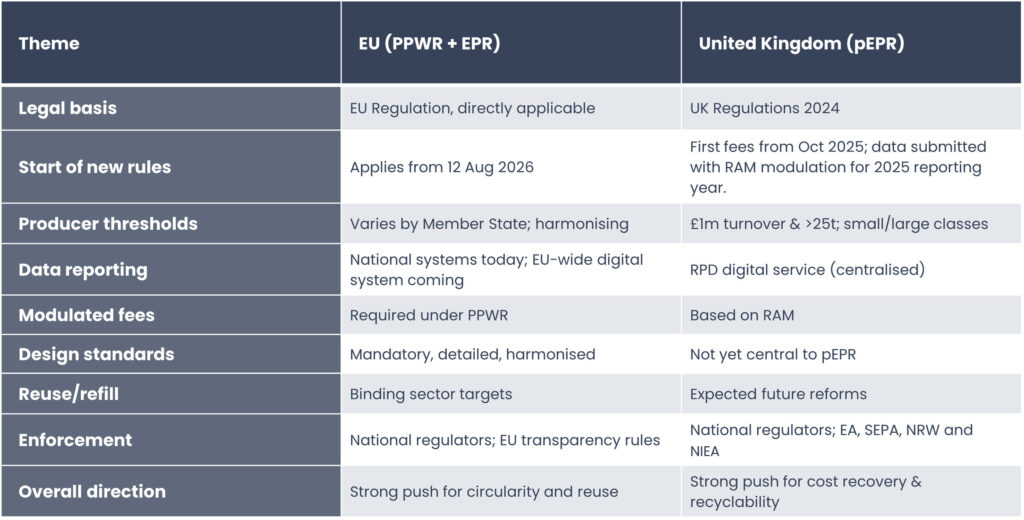
Summary Table: EU vs UK Packaging EPR at a glance

What this means for producers

Even if you operate solely within the UK, the EU’s Packaging and Packaging Waste Regulation (PPWR) will shape packaging expectations globally. From 2026, exporters to the EU, will need to meet stricter EU design, reuse, and recyclability requirements, supported by enhanced digital reporting and transparent enforcement.

At the same time, the UK’s system is evolving to link producer costs more closely to recyclability through the Recycling Assessment Method (RAM). This means accurate data, precise material classification, and optimised packaging design will be critical to managing future EPR fees.

As PPWR harmonises the EU landscape and the UK establishes its own model, producers will face two systems developing in parallel. Those who understand the divergence early gain the advantage: smarter design decisions, clearer investment cases, and faster adaptation.

Industry Insight: Getting Ahead of Regulation

While 2030 feels far away, the operational changes required are significant. Here is what forward-looking producers are doing now:

  • Assessing portfolio recyclability against 2030 requirements
  • Modelling financial exposure under various PPWR scenarios
  • Mapping internal data to meet future digital reporting formats

How Clarity can help

PPWR and the UK’s EPR reform shift packaging compliance from simple reporting to strategic accountability. The organisations moving early are not doing so just to be compliant, they are doing so because they want control.

Clarity helps you provide the visibility to plan budgets, redesign packaging portfolios, prioritise markets, and demonstrate to senior leadership that the business is proactively addressing its obligations.

Our experts support producers across the full compliance lifecycle:

  • Determining obligations in the UK, EU and other markets
  • Managing registrations and data submissions
  • Optimising packaging data to reduce modulated fees
  • Preparing for new PPWR design-for-recycling and reuse requirements
  • Providing ongoing policy updates and expert guidance

We stay on top of regulatory change so you can stay focused on running your business efficiently, compliantly and sustainably.

    Related News & Views